AI Agent Threat Modeling with the MAESTRO Framework
AI agent threat modeling with MAESTRO: a seven-layer method for finding agentic risks before you ship, mapped to OWASP, NIST AI RMF, and MITRE ATLAS.
AI agent threat modeling is where security for agentic systems should begin — before the first red-team probe, before the first line of remediation. Classic threat-modeling methods such as STRIDE were built for request-response software with deterministic control flow. They struggle with systems that reason, plan, call tools, retain memory, and coordinate with other agents. MAESTRO is a threat-modeling framework designed specifically for that world.
MAESTRO — Multi-Agent Environment, Security, Threat, Risk, and Outcome — was introduced by the Cloud Security Alliance as a layered method for reasoning about agentic AI risk. Rather than enumerating attacker actions against a single trust boundary, it decomposes an agent system into seven architectural layers and asks, at each one, what can go wrong and what compounds across layers. This post walks through those layers, shows how to run a MAESTRO session, and maps its output to the frameworks your auditors already recognise.
It pairs naturally with our OWASP agentic testing guide and NIST AI RMF compliance testing posts: MAESTRO tells you where to look; those tell you what to test and how to document it.
Why STRIDE Is Not Enough
STRIDE (Spoofing, Tampering, Repudiation, Information disclosure, Denial of service, Elevation of privilege) remains excellent for the infrastructure and API layers of an agent system. But it assumes an attacker acting on a system from outside a defined boundary. Agentic systems break that assumption in three ways.
First, the model itself is an attack surface: prompt injection, jailbreaking, and goal hijacking have no clean STRIDE category. Second, agents blur the data/instruction boundary — retrieved documents and tool outputs can become instructions, so “information disclosure” and “tampering” collapse into each other. Third, multi-agent systems create emergent risks — cascading failures, trust exploitation between agents — that no per-component analysis surfaces. MAESTRO keeps STRIDE’s discipline while adding the layers and cross-layer reasoning that agents demand.
The Seven Layers
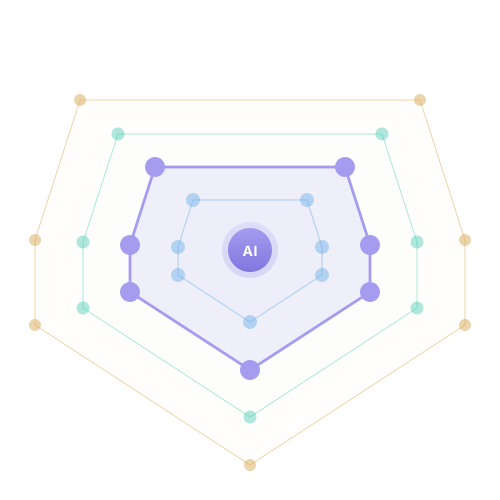
MAESTRO models an agent system as a stack. Threats are enumerated per layer, then examined for how they propagate upward and downward.
Layer 1 — Foundation Models. The underlying LLM. Threats: jailbreaks, adversarial prompts, training-data poisoning, model backdoors, and inherited biases. Also the model’s provenance and update cadence — a silent model swap can change your entire risk posture.
Layer 2 — Data Operations. Embeddings, vector stores, RAG pipelines, and memory. Threats: memory and context poisoning, retrieval-augmented injection, data exfiltration through embeddings, and stale or tampered knowledge that biases reasoning.
Layer 3 — Agent Frameworks. The orchestration libraries and tool interfaces (including MCP). Threats: tool poisoning, insecure tool schemas, unsafe tool composition, and framework vulnerabilities that expose the agent to injection.
Layer 4 — Deployment and Infrastructure. Containers, serverless runtimes, networking, and secrets management. Threats: sandbox escape, secret leakage, over-broad IAM roles, and the traditional cloud misconfigurations that give an injected agent somewhere to go.
Layer 5 — Evaluation and Observability. Logging, monitoring, and evaluation pipelines. Threats: insufficient logging that hides an incident, tampering with audit trails, and evaluation gaps that let behavioural drift go undetected.
Layer 6 — Security and Compliance. The controls layer: authentication, authorisation, guardrails, and policy enforcement. Threats: bypassable guardrails, over-provisioned identities, missing human-in-the-loop gates, and compliance drift against NIST or the EU AI Act.
Layer 7 — Agent Ecosystem. The multi-agent and human-agent environment. Threats: insecure inter-agent communication, agent impersonation, cascading failures, human-agent trust exploitation, and rogue agents operating beyond scope.
Cross-Layer Threats: Where the Real Risk Lives
The power of MAESTRO is not the per-layer lists — it is the insistence that you trace threats across layers. Most consequential agent incidents are compound: a weakness at one layer becomes catastrophic because of a condition at another.
Consider a single chain. A poisoned document enters at Layer 2 (data operations). The model at Layer 1 treats the embedded text as an instruction. At Layer 3, the agent framework dutifully invokes a tool. At Layer 4, that tool runs with an over-broad IAM role. At Layer 5, logging is too sparse to notice. The outcome is a data breach — but no single layer, examined alone, looks obviously broken. MAESTRO’s cross-layer pass is what surfaces the chain.
For each candidate threat, ask two questions: what does this enable at the layer above? and what condition at another layer would make this critical rather than trivial? The answers become your prioritised risk register. This is also where MAESTRO connects to MITRE ATLAS — ATLAS tactics and techniques give you a real-world adversary vocabulary to attach to each cross-layer chain, grounding the model in observed attacks rather than speculation.
Running a MAESTRO Session
A practical session follows six steps and typically takes a focused half-day for a single agent, longer for a fleet.
- Define the system. Draw the architecture: models, data stores, tools, deployment, and any other agents. Mark trust boundaries and data flows. You cannot model what you have not drawn.
- Assign components to layers. Place each element in one of the seven layers. Gaps here — a tool nobody can categorise, a data flow nobody owns — are themselves findings.
- Enumerate per-layer threats. Work through each layer with the threat categories above, made specific to your system. “Memory poisoning” becomes “an attacker seeds our support-ticket store with instructions the agent later retrieves.”
- Trace cross-layer chains. For each threat, follow it up and down the stack. Record the chains, not just the atoms.
- Score and prioritise. Rate each chain on likelihood and impact. Prioritise chains that cross the model layer and reach a state-changing tool or sensitive data.
- Map to controls and tests. For every prioritised chain, name the control that breaks it and the test that proves the control works. This is the handoff to red teaming.
The deliverable is a living document, not a one-off artefact. Re-run it after any material change: a new tool, a model swap, a new agent in the mesh.
Mapping MAESTRO to the Frameworks You Report On
MAESTRO is a discovery method; auditors want recognised frameworks. The two reinforce each other cleanly.
- OWASP Top 10 for Agentic Applications. Each MAESTRO layer maps to specific ASI risks — Layer 3 to tool misuse and supply chain (ASI02, ASI04), Layer 7 to inter-agent comms, cascading failures, and rogue agents (ASI07, ASI08, ASI10). Use OWASP as the checklist that your per-layer enumeration must at least cover.
- NIST AI RMF. MAESTRO’s layered enumeration feeds directly into the Map and Measure functions. The cross-layer register is evidence for Govern and Manage. See our NIST AI RMF testing guide for the documentation format.
- MITRE ATLAS. Attach ATLAS techniques to each cross-layer chain to ground threats in observed adversary behaviour.
Together, MAESTRO gives you the where, OWASP the what, ATLAS the how attackers really do it, and NIST the how you prove it to an auditor.
FAQ
What does MAESTRO stand for? Multi-Agent Environment, Security, Threat, Risk, and Outcome. It is a layered threat-modeling framework for agentic AI, introduced by the Cloud Security Alliance, that decomposes an agent system into seven architectural layers and reasons about threats within and across them.
How is MAESTRO different from STRIDE? STRIDE targets deterministic request-response software and a single trust boundary. MAESTRO adds layers for the model, data operations, agent frameworks, and the multi-agent ecosystem, and it emphasises cross-layer threat chains — the compound failures that single-component methods miss. Many teams use STRIDE for the infrastructure layers and MAESTRO for the agent-specific ones.
When should we run a MAESTRO threat model? Before shipping any new agent, and again after any material change — a new tool integration, a foundation-model swap, a new agent added to a mesh, or a change to the permission model. It is a living artefact, not a one-time gate.
Does MAESTRO replace red teaming? No. MAESTRO tells you where to look and what to prioritise; red teaming proves whether the risks are exploitable and whether your controls hold. Threat modeling and red teaming are complementary — the model scopes the test plan, and the test validates the model.
Model Your Agents Before Attackers Do
A MAESTRO threat model turns a vague sense that “agents are risky” into a prioritised, testable register you can hand to engineering and show to an auditor. We run MAESTRO sessions as the front end of our assessments, then validate the highest-priority chains with targeted red teaming.
Want to talk through your architecture first? Book a 30-minute call, email security@aivyuh.com, or see our enterprise engagement models.
Related reading: