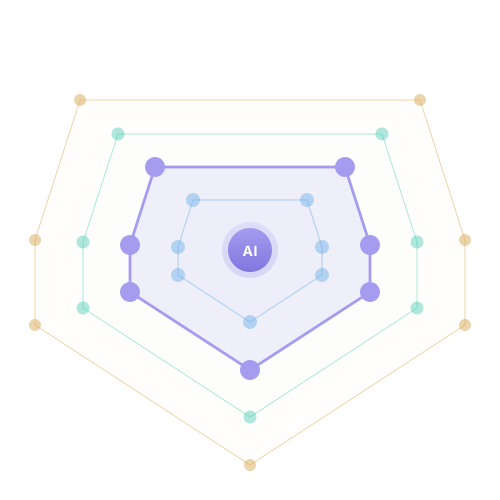
Mapping the AI Agent Attack Surface
Mapping the AI agent attack surface: the six layers — model, prompt, tools, memory, identity, multi-agent — where autonomous agents get compromised.
The AI agent attack surface is larger and stranger than most security teams assume, because an agent is not one thing — it is a model, a set of tools, a memory, an identity, and often a member of a multi-agent system, each of which an attacker can target independently or in combination. A traditional application has a well-understood surface: inputs, APIs, dependencies, infrastructure. An agent keeps all of that and adds a model that can be talked out of its instructions, tools that lend it real authority, and a memory that can be poisoned to shape future behaviour.
Mapping this surface is the prerequisite for defending it. You cannot secure what you have not enumerated, and the single most common cause of agent incidents is a component nobody thought of as an attack surface at all. This post lays out the six layers of the agent attack surface, the attacks that target each, and how they combine — the compound chains that turn a minor weakness into a breach. It draws together our deep dives on prompt injection, tool poisoning, and supply chain security, and complements the MAESTRO threat model.
Why Agents Expand the Surface
Three properties make agents fundamentally more exposed than the models they are built on.
They act, rather than merely respond. A chatbot’s worst output is bad text; an agent’s worst output is a bad action taken with real credentials — a deleted record, an exfiltrated file, an unauthorised transaction. Impact, not just accuracy, is at stake.
They ingest untrusted content as instructions. Everything an agent reads — user input, retrieved documents, tool outputs, tool descriptions — enters the same context as its instructions, and the model cannot reliably tell them apart. Every input channel is therefore a potential command channel.
They compose. Agents call tools, tools return data that feeds the next decision, agents call other agents. This composition creates chains and lateral movement paths that do not exist in single-component systems. The surface is not a list of doors; it is a graph of connected rooms.
Layer 1: The Model
The foundation model is the innermost surface. Attacks here target the model’s reasoning directly: jailbreaks that defeat safety training, adversarial prompts that elicit prohibited behaviour, and goal hijacking that redirects the agent’s objective. Because the model is where instructions and data blur, it is also the entry point for prompt injection, though the payload usually arrives from an outer layer.
Model-layer concerns also include provenance: a silent version swap by the provider can change safety behaviour and tool-calling patterns without any change to your code. Treat the model’s identity and version as part of the surface you monitor, not a fixed constant.
Layer 2: The Prompt and Instruction Channel
The prompt layer is the system prompt, the instruction scaffolding, and every path by which text reaches the model’s context. This is the primary target for prompt injection — both direct, from user input, and indirect, from content the agent processes. It also includes system-prompt leakage (revealing the agent’s instructions and guardrails to an attacker who can then craft around them) and instruction override, where injected text supplants the developer’s directives.
The defining property of this layer is that it has no clean boundary. Any channel that can place text in the context window — a web page, an email, a database record, a tool’s output — is part of the prompt attack surface, which is why indirect injection is so hard to contain.
Layer 3: Tools and Actions
The tool layer is where an agent’s authority lives, and therefore where the highest-impact attacks land. It includes every tool, API, function, and MCP server the agent can invoke. Attacks here include tool poisoning (adversarial instructions in tool descriptions), tool misuse (safe tools composed into harmful outcomes), parameter injection (smuggling shell metacharacters or unexpected values into tool calls), and unsafe tool chaining (read → transform → send sequences that exfiltrate data through legitimate tools).
This layer is also where the confused deputy problem manifests: the agent holds real credentials, and an attacker who can influence its instructions can make it exercise that authority on their behalf. The size of this layer is roughly the number of tools multiplied by the permissions each one carries — which is why least privilege here is the highest-leverage control in agent security.
Layer 4: Memory and Data
The memory layer covers persistent memory, conversation context, embeddings, vector stores, and RAG pipelines. Attacks here play the long game: memory poisoning seeds malicious entries that bias future decisions; RAG poisoning plants documents whose embedded instructions the agent later retrieves and follows; context manipulation exploits multi-turn conversations to activate injected instructions on a later turn.
What makes this layer dangerous is delay. A poisoned document planted today may only trigger next week, when the agent retrieves it under the right conditions — decoupling cause from effect and making incidents hard to trace. Data exfiltration also lives here: sensitive content in memory or a retrieval source that an injection can coax into an output channel.
Layer 5: Identity and Privilege
The identity layer is the agent’s authentication and authorisation: its service accounts, tokens, API keys, and permission scopes. Attacks target over-provisioning (an agent with far more access than its task requires), credential exposure (keys leaking into logs, error messages, or outputs), and privilege escalation (an injected agent reaching resources beyond its mandate).
This layer is a force multiplier for every other one. A prompt injection against an over-privileged agent becomes a privilege escalation; the same injection against a least-privilege agent is contained. Short-lived, narrowly scoped, just-in-time credentials shrink this surface directly, and are the reason least privilege recurs as the throughline of agent defence.
Layer 6: Multi-Agent and Human Interfaces
The outermost layer is the environment the agent operates in: other agents and the humans supervising it. Multi-agent attacks include impersonation (spoofing one agent to another), insecure inter-agent communication (unauthenticated or unencrypted channels enabling agent-in-the-middle injection), cascading failures (one compromised agent propagating fault across the system), and rogue agents (drift or compromise producing out-of-scope behaviour).
The human interface is its own surface: trust exploitation, where an agent presents a harmful action with the same confident polish as a routine one, and approval fatigue, where an operator rubber-stamps the malicious request buried among fifty benign ones. Attacks here exploit people and coordination rather than code, and they are easy to overlook precisely because they are not “technical.”
Compound Attacks: Where the Surface Becomes a Chain
The layers are not independent, and the most serious incidents cross several. A representative chain: a poisoned document enters at the memory layer; the model treats its embedded text as an instruction at the prompt layer; the agent invokes a tool at the tool layer; that tool runs with an over-broad token at the identity layer; and sparse logging at the observability layer hides it until the data is gone. No single layer looks obviously broken — the breach is emergent.
Mapping the surface layer by layer is necessary but not sufficient; you must also trace how a weakness in one layer becomes catastrophic given a condition in another. This cross-layer analysis is exactly what the MAESTRO framework formalises, and it is why a complete assessment tests chains, not just components.
FAQ
What is the AI agent attack surface? It is the complete set of points where an AI agent can be attacked, spanning six layers: the foundation model, the prompt and instruction channel, tools and actions, memory and data, identity and privilege, and the multi-agent and human environment. It is larger than a traditional application’s surface because agents act with real authority and treat untrusted content as instructions.
How is an agent’s attack surface different from a chatbot’s? A chatbot’s worst outcome is bad text; an agent’s is a harmful action taken with real credentials. Agents add tools, persistent memory, an identity with permissions, and often other agents — each an independent surface. Agents also compose, creating multi-step chains and lateral movement paths that single-response chatbots do not have.
Which layer is most important to secure? The identity and privilege layer has the highest leverage, because it caps the impact of failures everywhere else. A successful attack at any layer can only cause harm proportional to the authority the agent holds. Least privilege — short-lived, narrowly scoped credentials per tool — turns many potential breaches into contained, low-impact events.
How do I map my own agent’s attack surface? Enumerate every component across the six layers: models and versions, instruction channels, tools and their permissions, memory and retrieval sources, credentials and scopes, and any other agents or human approval steps. Then trace cross-layer chains — how a weakness at one layer becomes critical given a condition at another. A structured method like MAESTRO makes this repeatable.
Map and Defend Your Agent Surface
Most teams discover a component they never counted as an attack surface only after it is exploited. We map all six layers of your agents, trace the compound chains that turn minor weaknesses into breaches, and validate your controls with red teaming — mapped to OWASP and NIST AI RMF.
Want to walk your architecture first? Book a 30-minute call, email security@aivyuh.com, or see our enterprise engagement models.
Related reading: